Boundary conditions (b.c.) are constraints necessary for the solution of a boundary value problem. A boundary value problem is a differential equation (or system of differential equations) to be solved in a domain on whose boundary a set of conditions is known. It is opposed to the “initial value problem”, in which only the conditions on one extreme of the interval are known. Boundary value problems are extremely important as they model a vast amount of phenomena and applications, from solid mechanics to heat transfer, from fluid mechanics to acoustic diffusion. They arise naturally in every problem based on a differential equation to be solved in space, while initial value problems usually refer to problems to be solved in time. Boundary value problems have been extensively studied by Jacques Charles François Sturm (1803-1855) and Joseph Liouville (1809-1882), who studied the eigenvalues of a linear differential equation of the second order1. They studied the conditions which guarantee the existence and uniqueness of the solution of the differential problem and how it is affected by the boundary conditions2. The Sturm-Liouville theory is extremely important for any computational problem because it enables to understand if a problem is “well-posed” and how it is possible to obtain the solution.
Example: Both ordinary and partial differential equations need boundary conditions to be solved. Different types of boundary conditions can be imposed on the boundary of the domain.
es: Condiciones de frontera
Emissivity
Noun
The relative power of a surface to emit heat by radiation : the ratio of the radiant energy emitted by a surface to that emitted by a blackbody at the same temperature.
The emissivity of the surface of a material is its effectiveness in emitting energy as thermal radiation. Thermal radiation is electromagnetic radiation that may include both visible radiation (light) and infrared radiation, which is not visible to human eyes. The thermal radiation from very hot objects (see photograph) is easily visible to the eye. Quantitatively, emissivity is the ratio of the thermal radiation from a surface to the radiation from an ideal black surface at the same temperature as given by the Stefan–Boltzmann law. The ratio varies from 0 to 1. The surface of a perfect black body (with an emissivity of 1) emits thermal radiation at the rate of approximately 448 watts per square metre at room temperature (25 °C, 298.15 K); all real objects have emissivities less than 1.0, and emit radiation at correspondingly lower rates.
Example: Emissivity of a planet is determined by the nature of its surface and atmosphere.
es: Emisividad
Energy balance
Verb
The concept of energy balance is based on the fundamental thermodynamic principle that energy cannot be destroyed, and can only be gained, lost, or stored by an organism. Energy balance is defined as the state achieved when the energy intake equals energy expenditure. This concept may be used to demonstrate how bodyweight will change over time in response to changes in energy intake and expenditure. When the body is in energy balance, bodyweight is stable. Humans take in energy through the intake of food and drink, and expend energy through the resting metabolic rate (RMR)—the thermic effect (TEF) of food and physical activity. The RMR is the energy expenditure required for maintaining normal body functions and homeostasis. The RMR is proportional to body mass, in particular fat-free mass. TEF refers to the energy required to absorb, digest, and metabolise the food consumed and typically accounts for 8–10 % of daily energy expenditure. The energy expended due to physical activity (EEact) accounts for energy that is expended in addition to the RMR and TEF, including voluntary exercise, shivering, postural control, and voluntary movement. It is calculated by multiplying the energy expenditure of an activity by the time spent performing it, and is the most variable component of energy expenditure.10 The more sedentary the individual is, the lower the effect of physical activity. This may be as low as 100 calories per day, whereas elite athletes may expend 3,000 calories per day of physical activity. The decline in energy expenditure that occurs with advancing age is mainly the results of declining lean body mass, which reduces TEF and EEact.
Example: Disturbances in energy balance cause changes in body mass, although the timeframe over which this occurs varies between individuals and may explain the large interindividual response to weight-loss interventions.
es: Balance de energía
Heat conduction equation
Noun
The heat conduction equation is a partial differential equation that describes the distribution of heat (or the temperature field) in a given body over time. Detailed knowledge of the temperature field is very important in thermal conduction through materials. Once this temperature distribution is known, the conduction heat flux at any point in the material or on its surface may be computed from Fourier’s law.
The heat conduction equation is a partial differential equation that describes the distribution of heat (or the temperature field) in a given body over time. Detailed knowledge of the temperature field is very important in thermal conduction through materials. Once this temperature distribution is known, the conduction heat flux at any point in the material or on its surface may be computed from Fourier’s law.
The heat equation is derived from Fourier’s law and conservation of energy. The Fourier’s law states that the time rate of heat transfer through a material is proportional to the negative gradient in the temperature and to the area, at right angles to that gradient, through which the heat flows.
Example: The Heat Conduction Equation (Figure 20.4.6) governs time response and other heat flow phenomena. Solutions to the Heat Conduction Equation consist of a time-independent final temperature distribution and a series sum of exponentially damped orthogonal functions that describe the evolution of the temperature distribution from the initial condition f(x) to the final condition.
es: Ecuación de conducción de calor
Heat flux
Noun
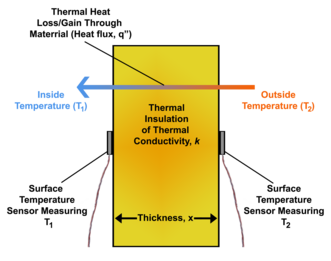
Heat Flux is the rate of heat energy that passes through a surface. Depending on the exact definition of heat flux, its unit can be expressed as either W/m2 or W.
Heat flux originates from temperature differences
Temperature differences in a given system induce a heat flux. The induced heat flux always flows from the hot to the cold side. Heat fluxes are everywhere. Some examples are:
Getting cold feet from standing on a cold floor: since the floor has a lower temperature than the feet, heat flows from the feet to the floor.
Standing close to a fire feels hot: the temperature of a fire is much higher than the surrounding air. Therefore, heat radiates from the fire to the surroundings.
Feeling hot in a sauna: since the air temperature in a sauna is higher than the body’s temperature, heat flows from the air into the body.
In order for heat flux to exist, it requires, not only a temperature difference, but also a medium through which heat is flowing. Heat can flow through solid materials (in which case it is called conduction), through gases and liquids (which is called convection) and through electromagnetic waves (which is called radiation).
Example: Heat flux or thermal flux, sometimes also referred to as heat flux density, heat-flow density or heat flow rate intensity is a flow of energy per unit of area per unit of time.
es: Flujo de calor
Insulation
Noun
Thermal insulation is the method of inhibiting the transfer of thermal energy from one area to another. In other words, thermal insulation can keep an enclosed area such as a building warm, or it can keep the inside of a container cold.
Heat is transferred by from one material to another by conduction, convection and/or radiation. Insulators are used to minimize that transfer of heat energy. In home insulation, the R-value is an indication of how well a material insulates.
Most insulation is used to prevent the conduction of heat. In some cases radiation is a factor. A good insulator is obviously a poor conductor.
Less dense materials are better insulators. The denser the material, the closer its atoms are together. That means the transfer of energy of one atom to the next is more effective. Thus, gases insulate better than liquids, which in turn insulate better than solids.
An interesting fact is that poor conductors of electricity are also poor heat conductors. Wood is a much better insulator than copper. The reason is that metals that conduct electricity allow free electrons to roam through the material. This enhances the transfer of energy from one area to another in the metal. Without this ability, the material--like wood--does not conduct heat well.
Conduction occurs when materials—especially solids—are in direct contact with each other. High kinetic energy atoms and molecules bump into their neighbors, increasing the neighbor's energy. This increase in energy can flow through materials and from one material to another.
Example: Insulation from heat transfer by convection is usually done by either preventing the motion of the fluid or protecting from the convection. Wearing protective clothing on a cold, windy day will inhibit the loss of heat due to convection.
es: Aislamiento
Internal energy
Noun
Internal energy is defined as the energy associated with the random, disordered motion of molecules. It is separated in scale from the macroscopic ordered energy associated with moving objects; it refers to the invisible microscopic energy on the atomic and molecular scale. For example, a room temperature glass of water sitting on a table has no apparent energy, either potential or kinetic. But on the microscopic scale it is a seething mass of high speed molecules traveling at hundreds of meters per second. If the water were tossed across the room, this microscopic energy would not necessarily be changed when we superimpose an ordered large scale motion on the water as a whole.
Example: Internal energy involves energy on the microscopic scale. For an ideal monoatomic gas, this is just the translational kinetic energy of the linear motion of the "hard sphere" type atoms, and the behavior of the system is well described by kinetic theory.
es: Energía interna
Isotropic system
Noun
Isotropy is uniformity in all orientations; it is derived from the Greek isos (ἴσος, "equal") and tropos (τρόπος, "way"). Precise definitions depend on the subject area. Exceptions, or inequalities, are frequently indicated by the prefix an, hence anisotropy. Anisotropy is also used to describe situations where properties vary systematically, dependent on direction. Isotropic radiation has the same intensity regardless of the direction of measurement, and an isotropic field exerts the same action regardless of how the test particle is oriented.
In the study of mechanical properties of materials, "isotropic" means having identical values of a property in all directions. This definition is also used in geology and mineralogy. Glass and metals are examples of isotropic materials. Common anisotropic materials include wood, because its material properties are different parallel and perpendicular to the grain, and layered rocks such as slate.
Isotropic materials are useful since they are easier to shape, and their behavior is easier to predict. Anisotropic materials can be tailored to the forces an object is expected to experience.
Example: Isotropic materials are materials whose properties remain the same when tested in different directions.
es: Sistema isotrópico
Specific heat
Noun
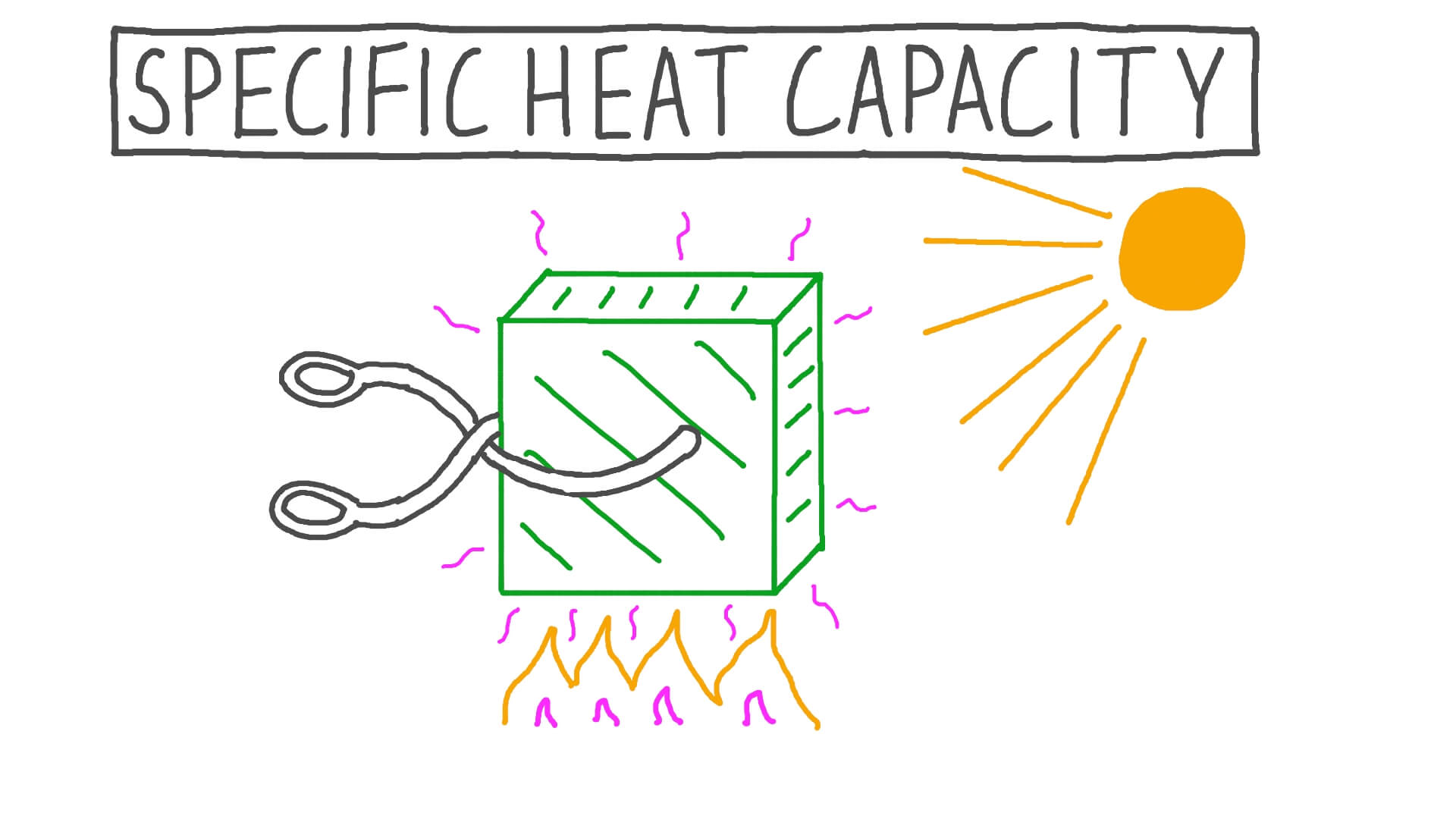
Specific heat, the quantity of heat required to raise the temperature of one gram of a substance by one Celsius degree. The units of specific heat are usually calories or joules per gram per Celsius degree. For example, the specific heat of water is 1 calorie (or 4,186 joules) per gram per Celsius degree. The Scottish scientist Joseph Black, in the 18th century, noticed that equal masses of different substances needed different amounts of heat to raise them through the same temperature interval, and, from this observation, he founded the concept of specific heat. In the early 19th century the French physicists Pierre-Louis Dulong and Alexis-Thérèse Petit demonstrated that measurements of specific heats of substances allow calculation of their atomic weights (see Dulong-Petit law). See also heat capacity.
The quantity of heat required to raise the temperature of one gram of a substance by one Celsius degree. The units of specific heat are usually calories or joules per gram per Celsius degree.
Example: The specific heat of a substance is the amount of energy required to raise the temperature of 1 gram of the substance by 1oC.
es: Calor especifico
Temperature
Noun
Temperature, measure of hotness or coldness expressed in terms of any of several arbitrary scales and indicating the direction in which heat energy will spontaneously flow—i.e., from a hotter body (one at a higher temperature) to a colder body (one at a lower temperature). Temperature is not the equivalent of the energy of a thermodynamic system; e.g., a burning match is at a much higher temperature than an iceberg, but the total heat energy contained in an iceberg is much greater than the energy contained in a match. Temperature, similar to pressure or density, is called an intensive property—one that is independent of the quantity of matter being considered—as distinguished from extensive properties, such as mass or volume.
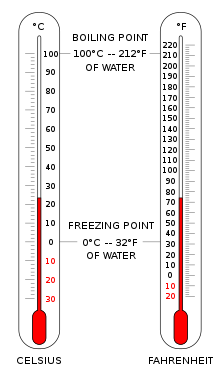
Three temperature scales are in general use today. The Fahrenheit (°F) temperature scale is used in the United States and a few other English-speaking countries. The Celsius (°C) temperature scale is standard in virtually all countries that have adopted the metric system of measurement, and it is widely used in the sciences. The Kelvin (K) scale, an absolute temperature scale (obtained by shifting the Celsius scale by −273.15° so that absolute zero coincides with 0 K), is recognized as the international standard for scientific temperature measurement.
Example: Temperature is measured with a thermometer. Thermometers are calibrated in various temperature scales that historically have used various reference points and thermometric substances for definition.
es: Temperatura
Temperature gradient
Noun
A temperature gradient is a physical quantity that describes in which direction and at what rate the temperature changes the most rapidly around a particular location. The temperature gradient is a dimensional quantity expressed in units of degrees (on a particular temperature scale) per unit length. The SI unit is kelvin per meter (K/m).
Temperature gradients in the atmosphere are important in the atmospheric sciences (meteorology, climatology and related fields).
Example: A temperature gradient is rate of change of temperature per unit change in the path taken by the observer.
es: Gradiente de temperatura
Thermal conductivity
Adjetive
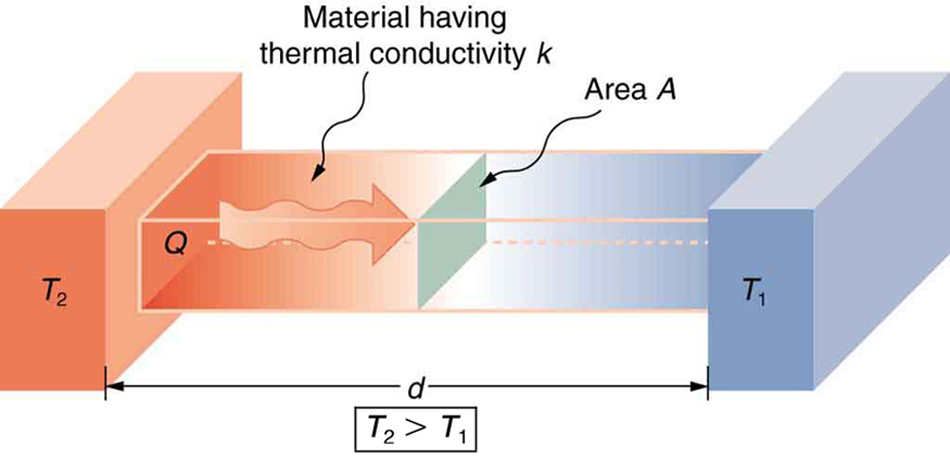
Thermal conductivity (often denoted by k, λ, or κ) refers to the intrinsic ability of a material to transfer or conduct heat. It is one of the three methods of heat transfer, the other two being convection and radiation. Heat transfer processes can be quantified in terms of appropriate rate equations. The rate equation in this heat transfer mode is based on Fourier’s law of heat conduction.
It is also defined as the amount of heat per unit time per unit area that can be conducted through a plate of unit thickness of a given material, the faces of the plate differing by one unit of temperature.
The thermal conductivity of a specific material is highly dependent on a number of factors. These include the temperature gradient, the properties of the material, and the path length that the heat follows.
The thermal conductivity of the materials around us varies substantially, from those with low conductivities such as air with a value of 0.024 W/m•K at 0°C to highly conductive metals like copper (385 W/m•K).
The thermal conductivity of materials determines how we use them, for example, those with low thermal conductivities are excellent at insulating our homes and businesses, while high thermal conductivity materials are ideal for applications where heat needs to be moved quickly and efficiently from one area to another, as in cooking utensils and cooling systems in electronic devices. By selecting materials with the thermal conductivity appropriate for the application, we can achieve the best performance possible.
Thermal conductivity occurs through molecular agitation and contact, and does not result in the bulk movement of the solid itself. Heat moves along a temperature gradient, from an area of high temperature and high molecular energy to an area with a lower temperature and lower molecular energy. This transfer will continue until thermal equilibrium is reached. The rate at which heat is transferred is dependent upon the magnitude of the temperature gradient, and the specific thermal characteristics of the material.
Due to the fact that molecular movement is the basis of thermal conductance, the temperature of a material has a large influence on the thermal conductivity. Molecules will move more quickly at higher temperatures, and therefore heat will be transferred through the material at a higher rate. This means that the thermal conductivity of the same sample has the potential to change drastically as the temperature increases or decreases.
The ability to understand the effect that temperature has on thermal conduction is critical to ensuring that products behave as expected when subjected to thermal stress. This is especially important when working with products that generate heat, such as electronics, and developing fire and heat protection materials.
Example: Thermal conductivity values vary substantially between material and are highly dependent on the structure of each specific material.
es: Conductividad térmica
Thermal diffusivity
Noun
Thermal diffusivity (a with the unit mm2/s) is a material-specific property for characterizing unsteady heat conduction. This value describes how quickly a material reacts to a change in temperature.
In order to predict cooling processes or to simulate temperature fields, the thermal diffusivity must be known; it is a requisite for solving the Fourier Differential Equation for unsteady heat conduction.
In heat transfer analysis, thermal diffusivity is the thermal conductivity divided by density and specific heat capacity at constant pressure. It measures the rate of transfer of heat of a material from the hot end to the cold end. It has the SI derived unit of m2/s. Thermal diffusivity is usually denoted α but a, h, κ (kappa), K, and D are also used.
Example: Thermal diffusivity is the thermal conductivity divided by density and specific heat capacity at constant pressure. It measures the ability of a material to conduct thermal energy relative to its ability to store thermal energy. High diffusivity means heat transfers rapidly.
es: Difusividad térmica
Thermal Energy
Noun
Thermal energy refers to the energy contained within a system that is responsible for its temperature. Heat is the flow of thermal energy. A whole branch of physics, thermodynamics, deals with how heat is transferred between different systems and how work is done in the process (see the 1ˢᵗ law of thermodynamics).
In the context of mechanics problems, we are usually interested in the role thermal energy plays in ensuring conservation of energy. Almost every transfer of energy that takes place in real-world physical systems does so with efficiency less than 100% and results in some thermal energy. This energy is usually in the form of low-level thermal energy. Here, low-level means that the temperature associated with the thermal energy is close to that of the environment. It is only possible to extract work when there is a temperature difference, so low-level thermal energy represents 'the end of the road' of energy transfer. No further useful work is possible; the energy is now 'lost to the environment'.
Example: The term 'thermal energy' is used differently, and often loosely, in different contexts. It refers to several distinct physical concepts, such as the internal energy, or as the enthalpy, of a body of matter and radiation.
es: Energía Térmica
Thermal symmetry
Noun/Adjetive
A special case of this condition corresponds to the perfectly insulated surface for which (∂T/∂x = 0). Heat transfer through a properly insulated surface can be taken to be zero since adequate insulation reduces heat transfer through a surface to negligible levels. Mathematically, this boundary condition can be expressed as: (see the image *1*)
Another very important case, that can be used for solving heat transfer problems involving fuel rods, is the thermal symmetry. For example, the two surfaces of a large hot plate of thickness L suspended vertically in air will be subjected to the same thermal conditions, and thus the temperature distribution will be symmetrical (i.e. in one half of the plate will be the same temperature profile as that in the other half). As a result, there must be a maximum in in the center line of the plate and the center line can be viewed as an insulated surface (∂T/∂x = 0). The thermal condition at this plane of symmetry can be expressed as: (see the image *2*)